All-or-nothing productivity begins with a promise that sounds reasonable: if I do it, I want to do it properly.
That promise can turn into a trap.
You text yourself the plan. You write the list. You imagine the clean version: full workout, full study session, full reset, full content day, full life overhaul. Then the day gets smaller than the plan.
You have twenty minutes instead of two hours. You are tired instead of sharp. The desk is not clear. You missed the ideal start time. The plan no longer looks perfect, so your brain quietly chooses nothing.
Nothing feels cleaner than doing it badly.
Perfection can disguise itself as standards
High standards are useful when they help you make something better. They become harmful when they prevent contact.
All-or-nothing thinking says:
- If I cannot do the full workout, it does not count.
- If I cannot study properly, why start?
- If I already missed the morning, the day is gone.
- If the plan broke, I need a fresh start.
- If I cannot be consistent, I should wait until I can.
The problem is not ambition. The problem is that your standard only allows ideal conditions.
Life rarely offers ideal conditions.
Partial progress is not fake progress
A ten-minute action can feel insulting when the goal is large. But partial progress does two important things.
First, it keeps the goal emotionally close. Avoidance makes goals grow teeth. Small contact keeps them ordinary.
Second, it creates evidence. You become someone who can touch the goal even when the conditions are imperfect.
That evidence matters more than the size of the session.
A short study block is not the same as finishing the course. It is proof that the course is still reachable.
A small walk is not the same as transforming your health. It is proof that your body is still in the conversation.
Create a menu of versions
Instead of one perfect plan, create three versions:
Full version: what you do when time and energy are good.
Useful version: what you do on a normal messy day.
Minimum version: what keeps the thread alive.
For example, writing:
- Full: draft 1,000 words.
- Useful: write one rough section.
- Minimum: open the document and write five bullet points.
Studying:
- Full: two chapters and practice questions.
- Useful: one section and five notes.
- Minimum: read one page and mark where to continue.
The minimum version is not a loophole. It is continuity.
Stop texting future-you a fantasy
Many self-plans fail because they are written by a version of you with temporary energy.
Future-you needs something more compassionate and more specific.
Instead of sending yourself:
"Tomorrow: fix everything."
Send:
"Tomorrow: open the file, work for twelve minutes, stop before making it huge."
That kind of plan is easier to trust because it does not require a personality transplant.
Let Catalyst help you resize the plan
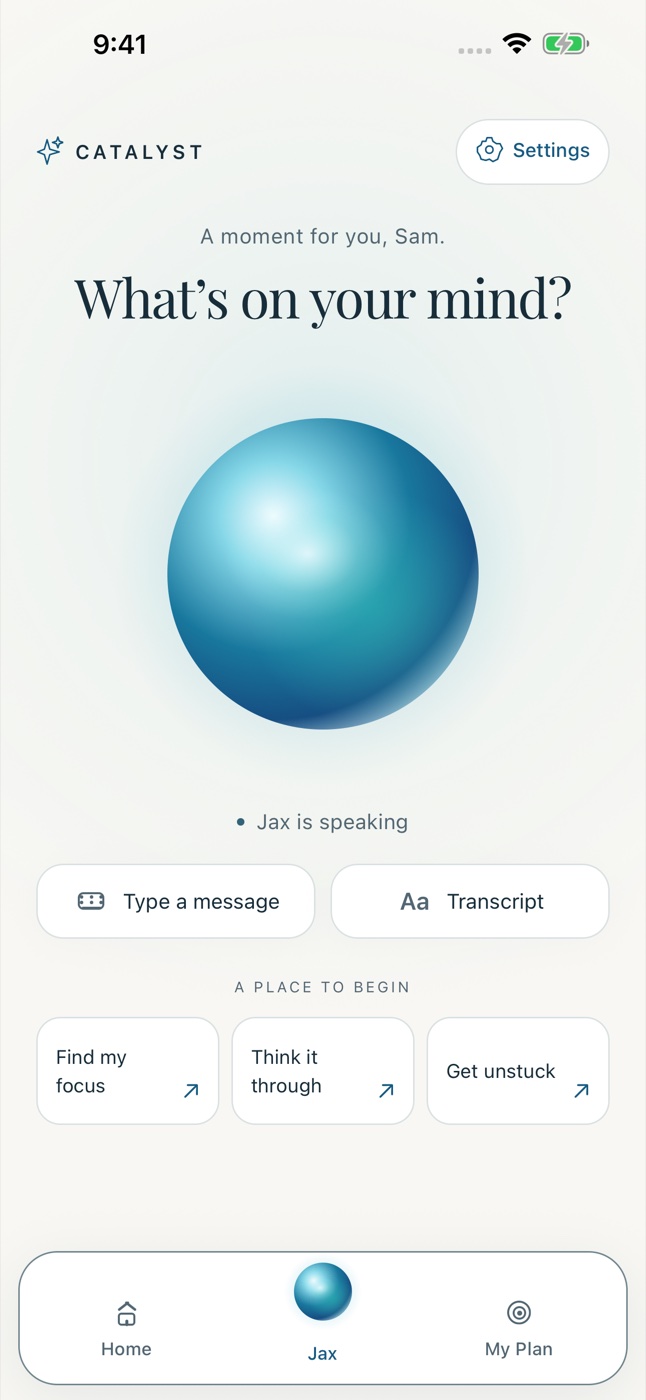
When you notice all-or-nothing thinking, use Catalyst as a resizing tool.
Say:
"Jax, I am making this too big. Give me the full version, useful version, and minimum version."
Or:
"I missed the ideal start. What still counts today?"
Because Catalyst is voice-first, you can catch the perfection loop in the moment, before you disappear into another reset. Jax can help turn a rigid plan into a flexible one without pretending the goal stopped mattering.
Use a completion phrase
After a minimum action, say something that marks it as real:
"That counts."
It may feel strange at first. But all-or-nothing thinking survives by denying credit for partial action. You need to train the opposite.
That counts because you returned.
That counts because you touched the work.
That counts because the goal stayed alive.
The imperfect version is the sustainable one
If your plan only works when your day is perfect, it is not a plan for your life. It is a plan for a fantasy calendar.
The imperfect version may feel less satisfying. It may not create the dramatic identity shift you wanted. But it gives you something better: continuity.
Most meaningful goals are not built by perfect days. They are built by people who learn how to keep the thread when the full plan is unavailable.
A small practice for this week
Choose one goal that keeps getting trapped in the full-or-nothing version. Write three acceptable versions of it before the next time you start.
For example, if the goal is exercise, the full version might be a full session, the useful version might be a short walk, and the minimum version might be changing clothes and stepping outside. If the goal is writing, the full version might be a complete draft, the useful version might be one section, and the minimum version might be five rough bullets.
The important part is deciding this before you are tired. When the hard moment arrives, you do not want to negotiate with perfection. You want a menu that already exists.
Then, when the minimum version happens, mark it as continuity. Not a failure. Not a joke. Continuity.
This slowly changes the relationship you have with imperfect action. The goal becomes something you can stay near, not something you only touch when the conditions are perfect. That is how the partial version becomes powerful. It keeps you in conversation with the life you are trying to build.
One last test: after reading this, choose one action you could do in less than ten minutes. If the action still feels too large, shrink it until it sounds almost ordinary. Ordinary is not a downgrade. Ordinary is where follow-through becomes possible. The goal is to leave with a next move, not a new reason to judge yourself.