You do know what to do. That is the frustrating part.
You know the email needs to be sent. You know the notes need to be opened. You know the workout, the study session, the invoice, the application, the outline, the uncomfortable call. The problem is not information.
The problem is the small impossible crossing between knowing and starting.
That gap can make you feel ridiculous. From the outside, the task may look simple. From inside your body, it can feel like the task has weight. You look at it, feel the pressure rise, and suddenly anything else seems easier: checking a tab, reorganizing the list, making coffee, researching the better method, deciding tomorrow will be cleaner.
Then tomorrow arrives with the same task still waiting.
Why knowing is not enough
Most productivity advice treats action like a knowledge problem. It assumes that if you understand the benefits, choose a priority, and write the task down, motion will follow.
But many stuck people already have the task written down. They have the list, the app, the reminder, the calendar block, the carefully named project. Some have tried everything: timers, blockers, journals, notebooks, templates, color-coded systems, and yet the same pattern returns.
That means the missing piece is not more advice. It is translation.
You need to translate a task from something your mind recognizes into something your body can begin.
"Work on the proposal" is not a start. It is a cloud.
"Open the proposal document and write the messy first sentence under the pricing section" is closer.
"Study" is not a start.
"Open chapter four, set a timer for twelve minutes, and copy the three headings onto a blank page" is closer.
A real first step has a door handle.
The task may be carrying more than the task
When a simple task feels impossible, ask what else is attached to it.
An email might carry possible rejection. A workout might carry evidence that you have fallen off again. A course might carry the fear that you are behind. A business task might carry the question of whether the whole dream is real.
That is why a twenty-minute task can create months of stress. The task is small. The meaning around it is not.
Try asking:
- What am I afraid this task will prove?
- What decision is hidden inside it?
- What would become true if I actually started?
- What part of this feels vague, exposed, boring, or too big?
Do not turn those questions into another analysis project. Use them to find the edge.
Shrink the entry, not the goal
People often hear "make it smaller" as if it means lowering ambition. That is not the point.
The goal can stay meaningful. The entry point needs to shrink.
If your goal is to build a business, the entry point might be writing one rough offer sentence. If your goal is to get healthier, the entry point might be putting on shoes and walking to the end of the block. If your goal is to finish a course, the entry point might be watching three minutes and writing one note.
You are not trying to complete the whole identity today. You are trying to create contact.
Contact matters because avoidance feeds on distance. The longer you avoid something, the more unreal and threatening it becomes. A tiny action breaks the spell. It gives your brain new evidence: I touched it and survived.
Use a spoken start when typing feels like another task
Sometimes opening the planner is part of the problem. The system has become another place where your intentions go to be judged.
This is where voice can help.
Instead of typing the perfect plan, say the messy truth out loud:
"I know what to do, but I keep not doing it. Help me find the first step."
That sentence is enough.
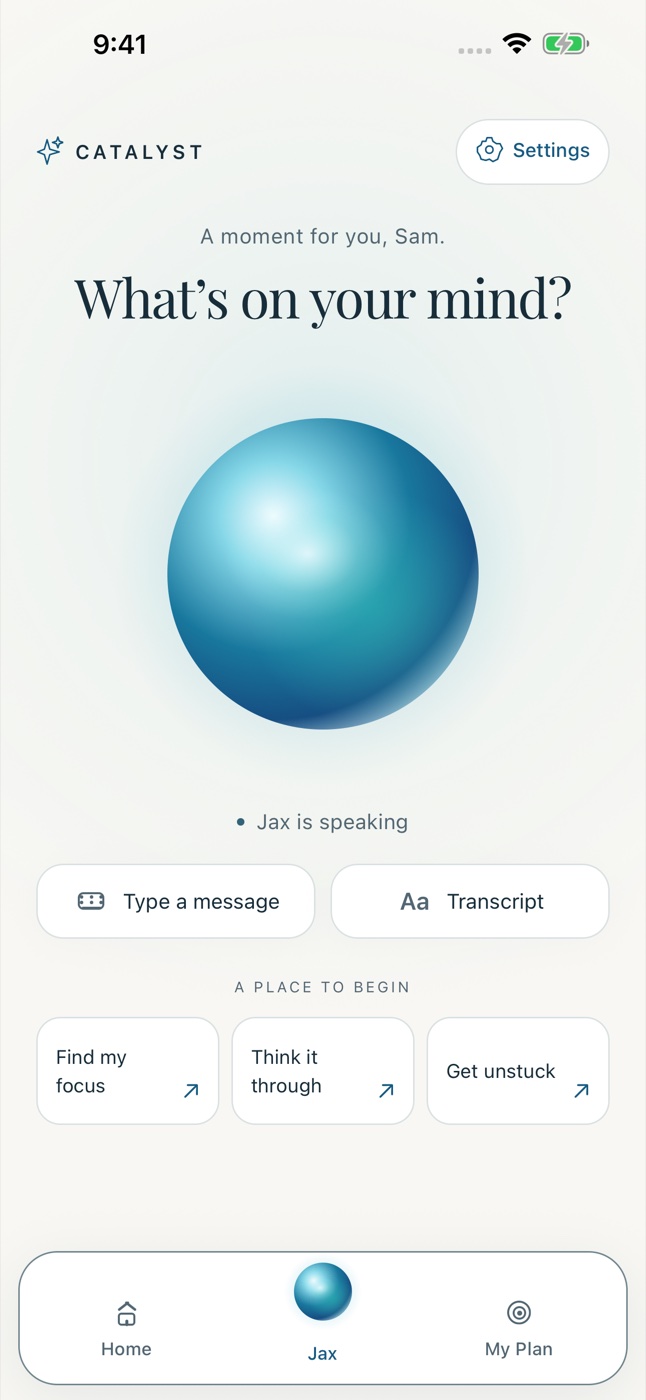
Catalyst is built for this kind of moment. Jax is not there to admire your list. He is there to help you cross from intention into motion. You can talk through what you are avoiding, what feels too large, and what one action would count today.
The value is not that an AI tells you a magic trick. The value is that you do not have to hold the whole knot alone while you are trying to untie it.
A five-minute crossing
Try this the next time you are stuck.
- Say the task out loud in its vague form.
- Say why you are avoiding it in one honest sentence.
- Ask, "What is the first visible action?"
- Make that action smaller until it takes less than five minutes.
- Do only that.
- Afterward, decide whether to continue.
The last part matters. You are allowed to stop after the first step. The goal is not to trap yourself into a huge session. The goal is to prove that starting is possible.
You are not missing character
The shame story says you are lazy, inconsistent, or broken. But if you keep returning to the same goal, you probably care. Caring is not the missing piece.
The missing piece is often a bridge that is small enough to cross while you are tired, unsure, or afraid.
When you know what to do but cannot do it, stop asking for a bigger lecture. Ask for the next door handle.
Then touch it.
Try the "before, during, after" check
When the same task keeps freezing you, look at where the resistance actually lives.
Before: Is the task too vague before you begin? Do you know the exact first movement, or only the category of work?
During: Does the task become uncomfortable once you touch it? Are you hitting boredom, confusion, fear of doing it wrong, or too many choices?
After: Is there a consequence you are quietly avoiding? A reply, a judgment, a new decision, a next step you do not want to face?
This matters because different stuck points need different support. If the problem is before, shrink the entry. If the problem is during, shorten the work block and define what counts. If the problem is after, name the consequence and decide whether it is real, imagined, or manageable.
Many people keep asking one global question: why can I not do this? A better question is: where exactly does the bridge collapse?
Once you know that, the next step can be designed for the actual gap instead of the imagined one.