If you only trust yourself on Day 1, build for Day 4.
Day 1 is usually not the problem. Day 1 has the clean notebook, the new plan, the emotional clarity, the promise that this time will be different. You can see the future version of yourself for a minute, and it feels close.
Then Day 4 arrives.
You slept badly. Work ran long. Someone needed you. The task feels less shiny. The plan that felt obvious now feels oddly heavy. You do one small thing, then drift. Or you do nothing and tell yourself you will restart Monday.
This is the chronic restarter loop: strong beginning, fast fade, shame, reset.
Motivation is not a stable fuel
Motivation is real, but it is not reliable. It rises when a goal feels new, emotionally charged, or connected to identity. It drops when the goal becomes ordinary work.
That drop does not mean the goal was fake. It means the goal has entered the middle.
The middle is where most goals live. Not in the inspiring decision. Not in the dramatic finish. In the repeated, slightly boring act of returning.
If your system only works when you feel charged, it is not a follow-through system. It is a launch system.
A launch system helps you begin. A follow-through system helps you continue after the emotional weather changes.
The Day 4 question
When you set a goal, ask this earlier than feels necessary:
What will I do when I do not feel like this anymore?
Not if. When.
The answer might be:
- I will reduce the step instead of quitting.
- I will check in before I restart the whole plan.
- I will keep a minimum version ready.
- I will ask for help choosing today's move.
- I will treat a missed day as information, not evidence.
This is not negative thinking. It is design.
You are building for the version of you who still cares but no longer has the emotional surge.
Make the minimum version real
A lot of people fail because their minimum version is still too large.
"Work out" becomes "do the full workout." "Study" becomes "catch up on everything." "Build the business" becomes "fix the website, write the offer, post content, and send outreach."
That is how a meaningful goal becomes impossible by breakfast.
A real minimum version is almost suspiciously small:
- Put the document on screen.
- Walk for eight minutes.
- Read one page.
- Write three bad bullets.
- Send one simple message.
- Spend ten minutes clearing the task you keep avoiding.
Small is not a consolation prize. Small is the thread you keep from snapping.
Stop restarting from zero
The restarter loop often includes a hidden rule: if you fall off, the whole thing is ruined.
That rule creates the Monday fantasy. You imagine a clean restart where everything is reset, but the clean restart keeps teaching your brain that imperfect continuity does not count.
A better question is: what would it look like to resume badly?
Not beautifully. Not with a new plan. Badly, quickly, honestly.
If you missed three days, do one small action today. If you missed three weeks, do one small action today. The return is the skill.
Use accountability without shame
Many people avoid accountability because it feels like being watched for failure. That kind of pressure can create a short burst, but it often backfires once you slip.
Good accountability is different. It helps you remember what mattered and choose a next step without turning one missed day into a character trial.
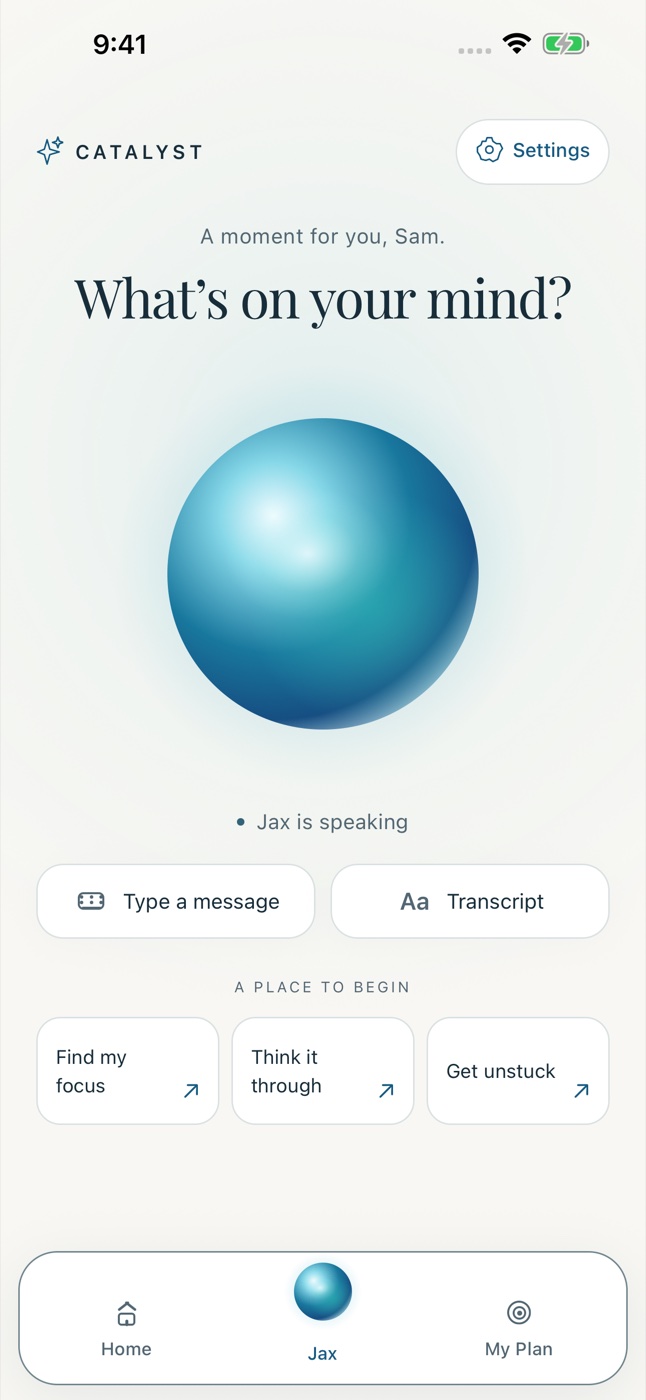
Catalyst is designed around that gentler kind of accountability. You can say to Jax:
"I was excited about this goal and now I do not feel motivated. Help me make a Day 4 version."
Or:
"I missed the last few days. Do not let me rebuild the whole thing. Help me resume."
That voice-first check-in matters because the moment motivation drops is exactly when opening and maintaining another system can feel like too much.
Build a return ritual
Try this when motivation disappears:
- Name the goal.
- Name the drop without drama.
- Choose the smallest continuation step.
- Schedule the next check-in.
- Leave the plan smaller than your ambition.
For example:
"I wanted to study every day. Motivation dropped. Today I will review one page and mark where I stopped. Tomorrow I will ask what comes next."
That is not a failure. That is continuity.
The win is coming back
You do not need to feel like Day 1 forever. You need a way to be supported on Day 4, Day 9, and the ordinary Tuesday when the goal has lost its sparkle.
Motivation disappearing is not the end of the goal. It is the point where the real system begins.
Make the restart boring
One reason motivation drops so hard is that restarting becomes dramatic. You imagine needing a whole new plan, a recommitment speech, a cleared schedule, and a better version of yourself. That makes returning expensive.
Make the restart boring instead.
A boring restart might be opening the app, saying what happened, and choosing one small action. It might be reviewing the last place you stopped. It might be doing the minimum version and leaving a note for tomorrow.
No ceremony. No new identity. No full reset.
The easier the restart, the less frightening it becomes to fall off. That does not make you careless. It makes you resilient. You are no longer depending on a perfect streak to protect the goal. You have a way back.
This is why Day 4 planning is so useful. You decide in advance that the goal is allowed to become ordinary. When the sparkle fades, you do not panic. You follow the quieter path you already built.