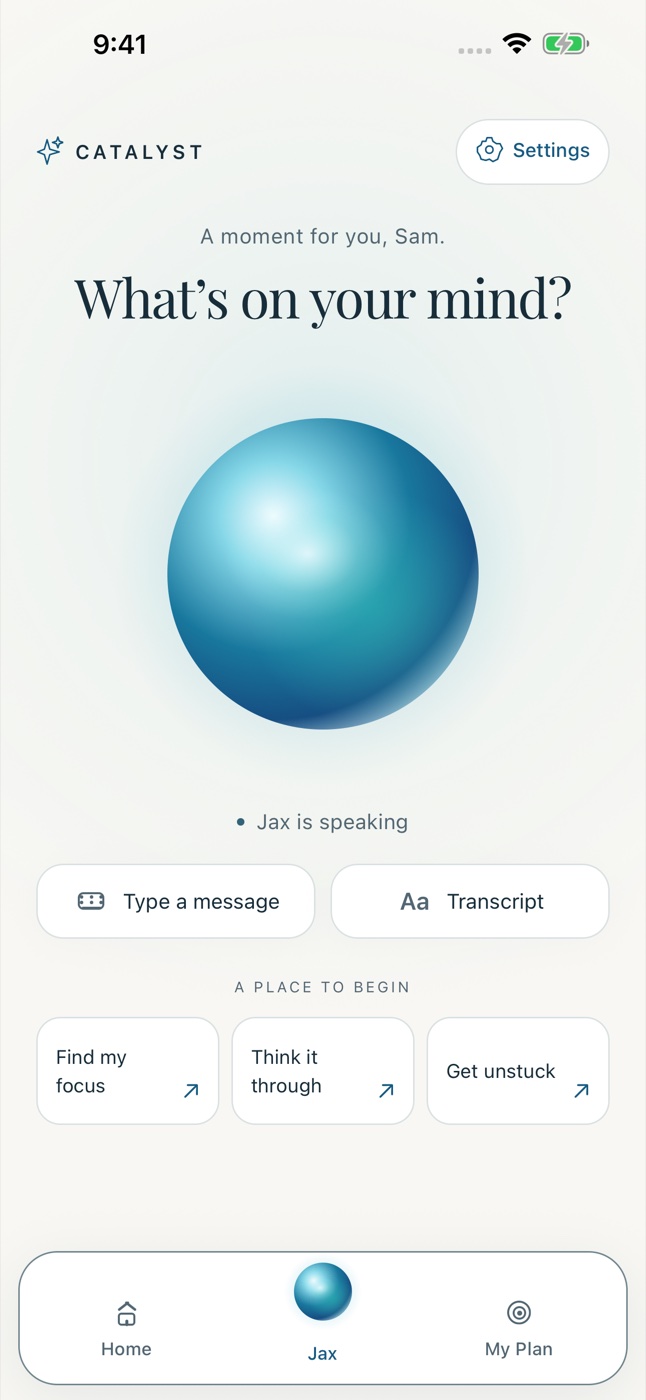
Planning your week when you have ADHD and too much going on can feel like trying to organize a room while everything is still falling off the shelves.
You might know what matters. You might even have the tools. But when the week has appointments, deadlines, errands, emotional stress, messages, bills, and half-finished projects, planning can become its own source of overwhelm.
The goal is not to build a perfect weekly plan. The goal is to make the week easier to enter.
Start by dumping the noise
Before you prioritize, capture the mess.
Open Catalyst and talk it out:
"Jax, help me plan my week. I have too much going on and I do not know where to start."
Then say everything. Work tasks. Personal tasks. Appointments. Worries. Things you keep remembering at the wrong time.
This is not the plan. This is the clearing step.
For many ADHD brains, the hardest part is holding all the loose threads at once. Voice helps because you do not have to make the list neat before getting it out of your head.
Separate anchors from extras
Once the noise is out, sort the week into three categories:
- Anchors: fixed commitments like meetings, classes, appointments, pickups, deadlines.
- Must-moves: the few actions that meaningfully reduce stress or move a goal forward.
- Extras: useful tasks that are allowed to wait.
Most weekly plans fail because everything gets treated like a must-move. That creates decision fatigue and panic.
Ask Jax:
"Which of these are anchors, which are must-moves, and which can wait?"
Pick fewer priorities than feels comfortable
If you have ADHD, a realistic week often needs fewer priorities and more buffers.
Try choosing one main outcome per day. Not five. One.
Monday might be "send the proposal." Tuesday might be "study chapter three." Wednesday might be "clean up the admin pile."
This does not mean you do only one thing all day. It means the day has one clear win. That gives your attention somewhere to land.
Plan for transitions
Weekly planning often ignores transitions: the time it takes to start, switch, recover, eat, drive, reply, reset, or find the file.
If your plan assumes you can instantly move from one task to another, it will break.
Build in soft edges:
- A 15-minute start block.
- A buffer after meetings.
- A low-energy task after a high-energy task.
- A check-in before the afternoon disappears.
Catalyst can help you turn a plan into something more humane:
"Jax, make this week realistic for my energy and attention."
Use a daily voice reset
A weekly plan is only useful if you can update it.
Each morning, ask:
"What matters today based on the week I planned?"
Each evening, ask:
"What changed, and what should move?"
That keeps the plan alive. You are not failing the plan; you are maintaining it.
If your week feels like too much, the answer is not a prettier planner. It is a planning system that can listen, adjust, and help you choose the next step when your brain is full.