Your setup is not the goal. The next ugly step is.
Planning can feel wonderfully responsible. You are not ignoring the goal. You are researching. Organizing. Making the better list. Comparing methods. Rebuilding the dashboard. Color-coding the categories. Watching one more video before you start.
It feels productive until you notice the strange truth: the real work has not moved.
This is the planning loop. It is especially painful because it looks like effort from the inside. You are tired at the end of it. You spent energy. You cared. But the thing you meant to do is still waiting.
Planning gives the illusion of control
A plan is useful when it reduces friction. It becomes avoidance when it protects you from contact with the work.
Doing the work involves uncertainty. You might be bad at it. You might choose the wrong path. You might discover the task is harder than expected. You might have to send the thing, show the thing, submit the thing, or admit you do not know yet.
Planning delays that exposure.
That is why the perfect system is so tempting. The system gives you a clean version of yourself: organized, strategic, in control. The actual first step gives you the messy version: learning, imperfect, visible.
Of course the system feels safer.
The difference between useful planning and avoidance planning
Useful planning answers a question that blocks action.
Avoidance planning creates more questions so action can stay postponed.
Useful planning sounds like:
- What is the next step?
- What materials do I need to begin?
- How much time do I have today?
- What would count as enough for this session?
Avoidance planning sounds like:
- What is the perfect method?
- What if this plan fails?
- Should I rebuild the whole structure?
- Which tool will finally make me consistent?
- How do I make sure I never waste effort?
The second set can keep you busy for weeks.
Make an action threshold
Before you plan, decide how much planning is allowed before action begins.
For example:
- I can plan for ten minutes, then I must do one visible step.
- I can choose one method for this week only.
- I can write a messy outline, but I cannot redesign the system.
- I can prepare the study space, then I must open the first page.
The threshold protects you from turning preparation into a second project.
Ask for the next ugly step
The word ugly is useful because perfectionism often hides inside planning.
An ugly step is allowed to be incomplete, rough, too small, and not impressive. It is allowed to be the version you would never post about.
Examples:
- Draft the bad first paragraph.
- List the three things you do not understand.
- Open the spreadsheet and label the columns.
- Record a two-minute voice note about the problem.
- Read one section without making perfect notes.
Ugly action is not the opposite of quality. It is the path to quality.
Use voice to interrupt the loop
If planning has become your avoidance pattern, writing another plan may not help. You may need a different doorway.
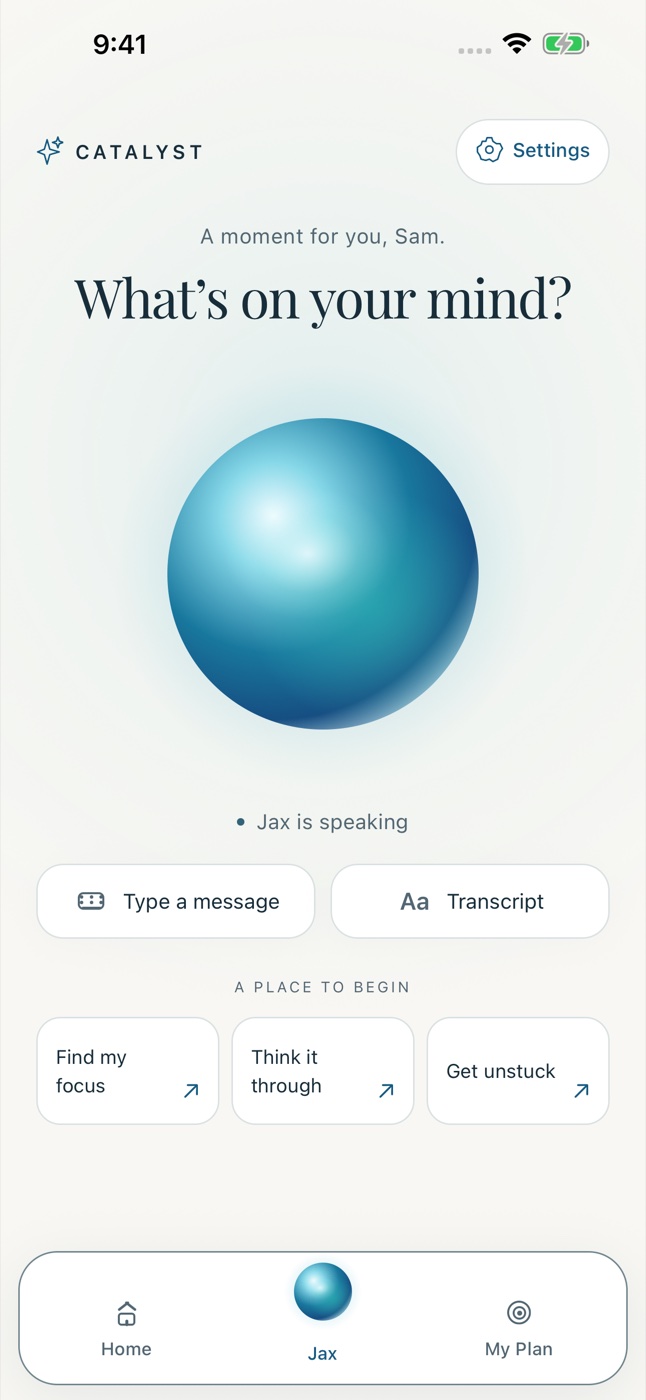
Open Catalyst and talk to Jax:
"I keep planning instead of doing. Do not help me build a bigger system. Help me choose one action."
That instruction matters. Catalyst should not become another place where the plan gets prettier while the goal stays untouched. Used well, it can help you name the loop, shrink the next step, and start before the system expands again.
You can also ask:
"What is the smallest proof that this goal moved today?"
That question pulls you back to reality.
Create a done signal for the planning session
Many people keep planning because there is no finish line. The plan can always be improved.
Set a done signal:
- One next action is written.
- One time block is chosen.
- One material is opened.
- One decision is made.
When the done signal appears, planning stops.
The plan should serve the work
Planning is not bad. A good plan can lower the noise and help you begin. But if the plan keeps asking for more care than the goal itself, it has taken over.
You do not need to become someone who never plans. You need to become someone who notices when planning has become a hiding place.
The next step will probably be smaller, messier, and less satisfying than the perfect plan.
That is why it works.
Keep a "planning debt" limit
Planning debt is the amount of preparation you have created but not converted into action. A little planning debt is normal. Too much becomes heavy.
If you have three calendars, two systems, a long list of methods, and no recent movement, the debt is too high. The answer is not a better master plan. The answer is a conversion rule.
For every planning session, require one action artifact. That might be a sent email, a created file, a solved problem, a read page, a drafted paragraph, or a scheduled appointment. Something in the world has to change.
This rule protects you from the intoxicating feeling of organization without motion. It also lowers the pressure on the plan. The plan does not need to become perfect. It needs to produce contact.
If you want to keep researching, earn the next research block with one action. That rhythm makes planning useful again. It becomes a bridge instead of a room you live in.
One last test: after reading this, choose one action you could do in less than ten minutes. If the action still feels too large, shrink it until it sounds almost ordinary. Ordinary is not a downgrade. Ordinary is where follow-through becomes possible. The goal is to leave with a next move, not a new reason to judge yourself.