If productivity apps do not work for you, you are not necessarily using them wrong.
Some apps are beautifully designed and still fail the moment your life gets complicated. You enter the tasks. You set the categories. You build the dashboard. For a few days, the app feels like a new version of you.
Then the maintenance starts.
Tasks need updating. Projects need sorting. Reminders need adjusting. Old items pile up. The app becomes a place you avoid because it shows too much evidence of what you meant to do.
Now the tool that was supposed to reduce mental load has become another system to maintain.
Many apps assume clarity you do not have yet
A task app works best when you already know the task, the priority, the deadline, and the next step.
But follow-through often breaks before that point.
You may know the general goal but not the next action. You may have ten competing priorities and no emotional bandwidth to choose. You may be avoiding the task because it carries fear, boredom, uncertainty, or shame.
A checkbox cannot always solve that.
The problem is not capture. The problem is conversion: turning the messy intention into a doable next move.
Setup can feel like progress
Productivity apps can accidentally reward preparation.
You choose templates, build views, sort tags, sync calendars, and create the perfect structure. It feels like action because it is work. But the real project may not have moved.
That does not mean planning is bad. It means the app can become a very polished avoidance space.
A useful question is:
Did this tool help me start, or did it help me organize the idea of starting?
If the answer is the second one, the system may be too heavy for the moment you are in.
Follow-through needs a return path
Most apps are good at showing what is overdue. Fewer are good at helping you return without shame.
When you miss a task, the system often just keeps displaying it. The overdue pile grows. The emotional cost of opening the app rises. Eventually, you stop looking.
A better follow-through system asks:
- What changed?
- What still matters?
- What can be removed?
- What can shrink?
- What is the next honest step?
That is coaching, not storage.
Why voice changes the format
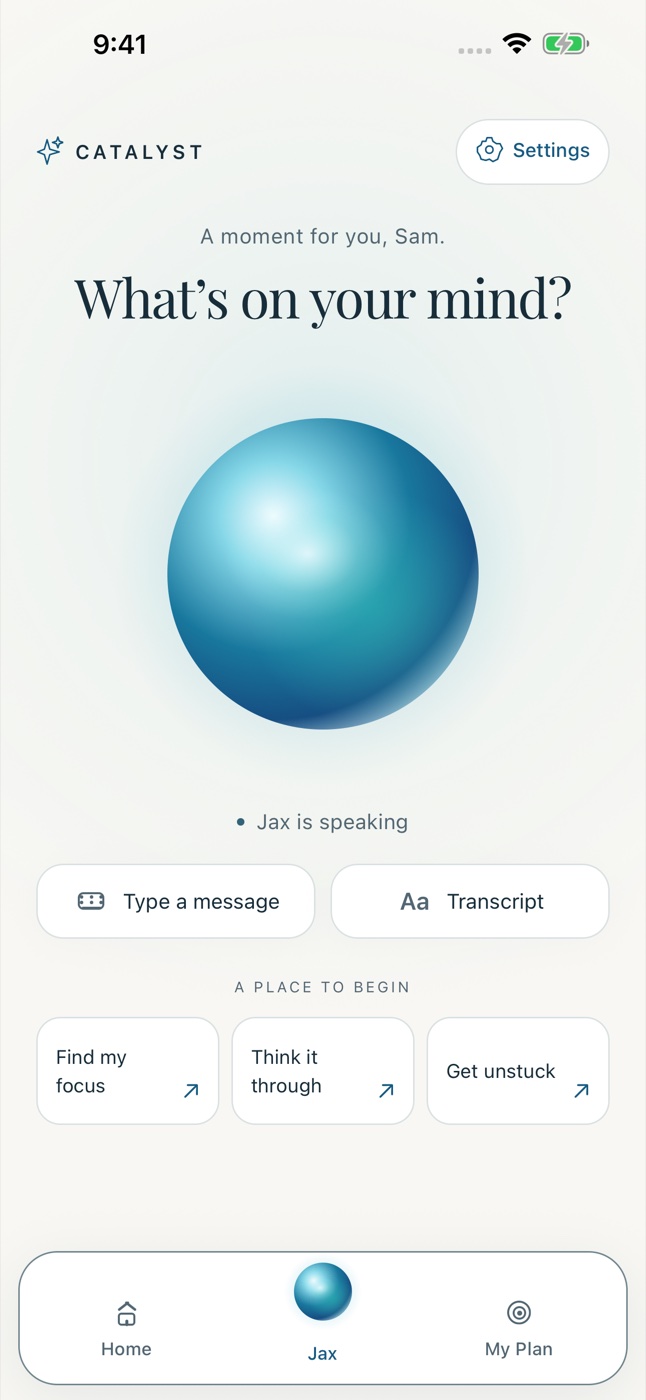
Catalyst is not trying to be another place where you perfect a dashboard. It is voice-first because many people think more honestly out loud than they type into a system.
You can say:
"Jax, I have tried apps and I keep abandoning them. Help me figure out what I actually need today."
Or:
"Here is the messy pile. Sort it with me and choose the next move."
The difference is that you are not starting by maintaining the tool. You are starting with a conversation.
That matters when the audience objection is already, "I do not want another productivity app."
When an app can help
A productivity app can help when it reduces decisions, lowers friction, and makes return easier.
It should not require you to become a project manager for your own life before you can do one task.
Look for support that:
- Accepts messy input.
- Helps prioritize.
- Breaks large goals into small actions.
- Lets plans change.
- Helps you restart after drift.
- Feels lighter after you use it, not heavier.
If an app only stores the plan, it may not be enough. If it helps you think, choose, begin, and return, it becomes a follow-through partner.
The tool should meet the stuck moment
Follow-through does not usually fail while you are calmly organizing. It fails when you are tired, uncertain, embarrassed, bored, or overloaded.
That is the moment the tool has to meet.
If opening the app feels like opening a report card, you will avoid it. If talking to it feels like getting help choosing one next step, you are more likely to come back.
You may not need a better dashboard.
You may need a way to say the truth out loud and have the next step become clear.
Audit the tool by the feeling it leaves behind
After you use any productivity tool, ask what state it leaves you in.
Do you feel clearer, or do you feel like you now have more to maintain? Do you know the next action, or do you only have a prettier list? Did the tool reduce shame, or did it create another place where you can watch yourself fall behind?
This audit is simple but revealing. A tool can look powerful and still be wrong for the moment you are in. If it requires too much setup, too many decisions, or too much cleanup after a missed week, it may not support follow-through.
The right tool should make contact easier. It should help you return after drift. It should lower the cost of telling the truth.
That does not mean every app has to be voice-first. It means the tool has to match the stuck point. If your stuck point is maintaining systems, adding a larger system will not save you.
One last test: after reading this, choose one action you could do in less than ten minutes. If the action still feels too large, shrink it until it sounds almost ordinary. Ordinary is not a downgrade. Ordinary is where follow-through becomes possible. The goal is to leave with a next move, not a new reason to judge yourself.
That is the quiet standard for this whole approach: less performance, more return. You do not need to make the moment impressive. You need to make it usable.