A simple morning routine you can stick to is probably less impressive than the one you imagine.
That is good news.
The routines that look beautiful online often ask a lot from a half-awake person: perfect timing, several habits stacked together, a spotless kitchen, a journal entry, a workout, a reading block, a complicated breakfast, a full identity shift before the day has even started.
For some people, that works. For many, it becomes another way to feel behind before breakfast.
A better morning default is boring on purpose.
The goal is fewer decisions
Morning routines fail when they require too many choices.
What should I eat? What should I wear? What matters today? Should I exercise? Should I check messages? Which task should I start with? Where did I leave the notebook?
Each decision costs attention. By the time you are supposed to begin the important thing, your brain has already spent energy negotiating the basics.
A default removes decisions before they appear.
Same simple breakfast. Same place for keys. Same notebook. Same first check-in. Same small planning question.
Not glamorous. Useful.
Build the routine around your real morning
Do not design for the morning you wish you had. Design for the one that keeps happening.
If you usually wake up tired, the default needs to be gentle. If your house is noisy, the default needs to be portable. If you get pulled into messages, the default needs to happen before the day becomes everyone else's.
Ask:
- What is the first decision that slows me down?
- What can I decide once?
- What can I prepare the night before?
- What is the smallest useful start?
- What would make tomorrow morning lighter?
The point is not to win the morning. The point is to enter the day with less friction.
Use anchors, not a long chain
A long habit chain breaks easily. One missed link can make the whole routine feel ruined.
Use anchors instead.
An anchor is a small reliable action that supports the next part of the day.
Examples:
- Drink water while coffee or tea starts.
- Open one notebook to today's page.
- Choose the first task before messages.
- Put the bag, keys, or materials in the same place.
- Spend two minutes naming the day out loud.
You do not need ten anchors. One or two may be enough.
Make the first task visible
A morning default should point toward the day, not become the whole day.
Before the morning ends, identify one action that matters.
Not everything. One action.
A useful prompt:
"If today gets messy, what would still make it count?"
That question keeps the routine connected to follow-through. Otherwise, the morning can become a performance you complete before avoiding the real thing.
Talk through the day before it scatters
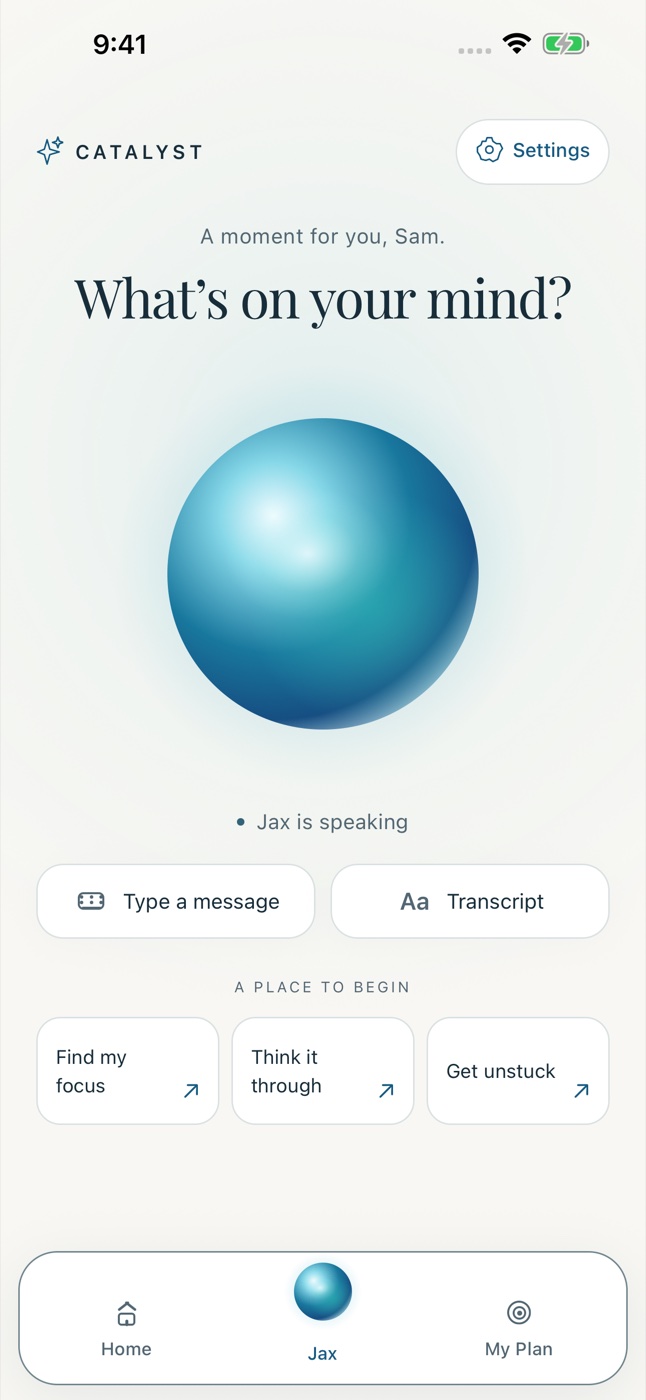
Catalyst fits naturally here because it is voice-first. You can talk to Jax while making coffee, packing a bag, or standing in the kitchen.
Try:
"Jax, help me choose the one thing that matters today. Keep it simple."
Or:
"What can I decide now so tomorrow morning is lighter?"
That kind of check-in turns the morning into a decision reducer. You are not maintaining another system. You are using a short conversation to find the next honest move.
Keep the default boring enough to repeat
If the routine needs novelty to survive, it may not be a default. It may be another project.
Boring can be kind:
- The same breakfast means one less choice.
- The same notebook means one less search.
- The same check-in means one less planning spiral.
- The same first question means the day has a door.
Boring does not mean lifeless. It means dependable.
Measure the morning by relief
A good morning default should make you feel a little less scattered. It should not create a new standard you can fail before the day begins.
After a week, ask:
- Did this reduce decisions?
- Did it help me start sooner?
- Did it make the day feel more humane?
- Did I recover when the morning went sideways?
If not, shrink it.
The routine you can keep is usually the one that asks less and supports more.
Let it be quiet. Let it be plain. Let it work.
The night-before version
A boring morning often starts the night before. Not with a long reset, but with one or two decisions removed from tomorrow.
Put the notebook where you will see it. Choose the first task. Set out the simple breakfast. Put the bag by the door. Leave the document open. Write the question you want to answer in the morning.
The point is not to optimize every minute. It is to reduce the number of moments where half-awake you has to negotiate.
You can also leave yourself a voice prompt:
"Tomorrow, ask Jax what one thing would make the day count."
That small instruction keeps the morning from expanding into a whole planning session. You wake up with a door already visible.
If the morning still goes sideways, the default can shrink. Maybe the only win is breakfast and one honest check-in. That still counts as a rhythm. The routine works because it is allowed to survive imperfect mornings.
One last test: after reading this, choose one action you could do in less than ten minutes. If the action still feels too large, shrink it until it sounds almost ordinary. Ordinary is not a downgrade. Ordinary is where follow-through becomes possible. The goal is to leave with a next move, not a new reason to judge yourself.