When you are too overwhelmed to begin, the problem is rarely that you do not care.
Often, you care so much that the task has become too large to touch.
You sit down to study or work and immediately see the whole mountain: every chapter, every deadline, every missing note, every bad past session, every consequence of being behind. Your brain tries to solve all of it before starting any of it.
So you prepare. You make a schedule, research methods, reorganize notes, choose music, adjust the desk, rewrite the plan.
An hour later, you are more tired and still have not begun.
Overwhelm expands the field
A focused task has edges. An overwhelming task has no edges.
"Study for the exam" contains too many decisions:
- Which chapter?
- Which method?
- Notes or practice questions?
- What if I am already behind?
- How long should I work?
- What if I do not understand it?
- What if I start wrong?
No wonder your brain looks for an escape.
The first job is not to become motivated. It is to reduce the field.
Choose one surface
Pick one surface where the work will happen.
Not the whole course. One page.
Not the whole project. One section.
Not the whole inbox. One message.
Not the whole workday. One twenty-minute block.
A surface is the smallest visible piece of the task that can receive attention.
For studying, it might be:
- The first page of chapter three.
- Five practice questions.
- One lecture slide.
- One blank page where you write what you remember.
For work, it might be:
- The opening paragraph.
- The next spreadsheet column.
- The unanswered client question.
- The file that needs review.
Start before the setup feels perfect
Setup can help, but it can also become a waiting room.
If you need water, get water. If you need the book, get the book. But do not require the perfect environment before the first contact.
The rule is simple: prepare only what the first twenty minutes require.
If the first twenty minutes require a textbook and a pen, stop there. Do not rebuild the desk. Do not research the best method. Do not create a full semester plan.
Begin with the materials you have.
Use a first-line prompt
A blank start can be brutal. Give yourself a first line.
For studying:
- "The three things I know are..."
- "The part I do not understand is..."
- "This section seems to be about..."
- "One question I can answer is..."
For work:
- "The purpose of this document is..."
- "The next decision is..."
- "The rough version should include..."
- "I am avoiding this because..."
A first line lowers the cost of entry.
Talk through the pile
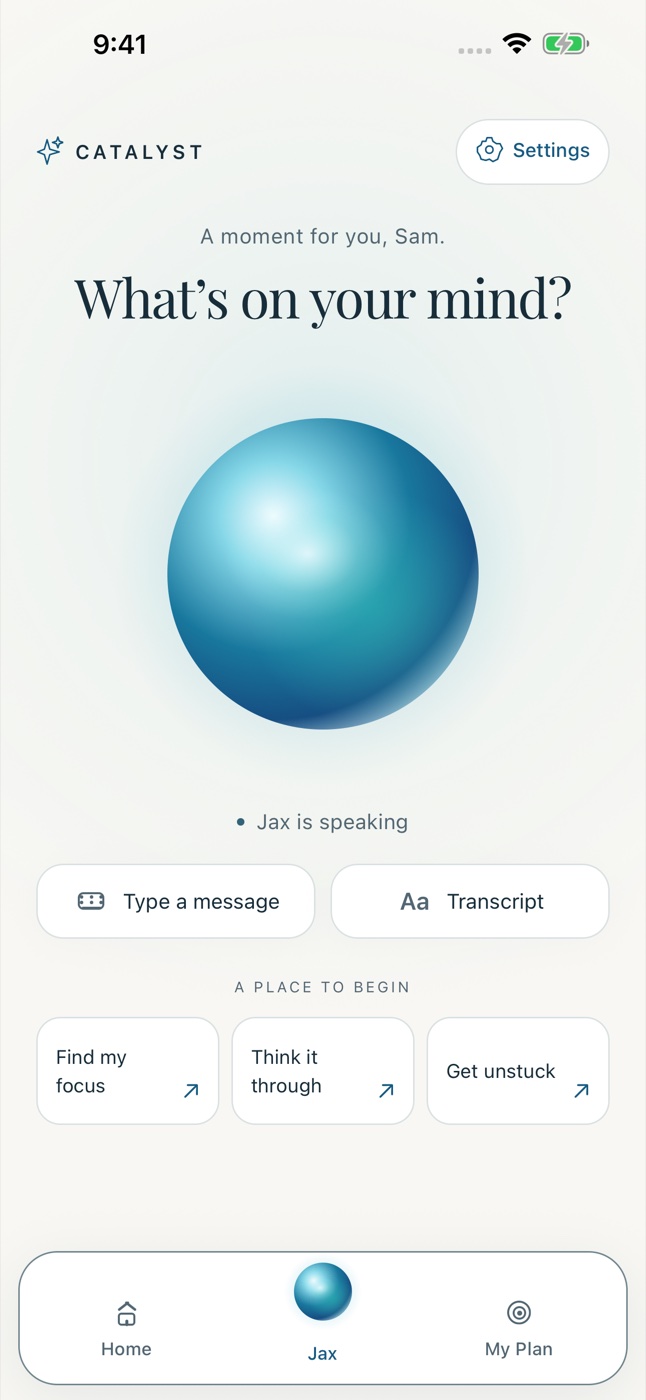
Catalyst can help when the task is too tangled to sort silently.
Say:
"Jax, I need to start studying, but I am overwhelmed. Pick one entry point and make it small."
Or:
"I need to work, but I keep preparing instead of starting. Help me begin with what I have."
Jax can help you choose the first surface, set a short container, and avoid turning the session into a perfect plan. The voice-first angle matters because overwhelmed people often need to dump the mess before they can see the next step.
Work in a short container
Set a container that is short enough to believe.
Twelve minutes can work. Fifteen can work. Twenty can work. The length matters less than the agreement: you only owe the container.
During the container, your job is not mastery. Your job is contact.
At the end, write one note:
- Where I stopped.
- What comes next.
- What is still confusing.
That note makes the next start easier.
Beginning is a separate skill
Do not judge a study or work session only by how much you finished. If overwhelm has been blocking you, beginning is its own win.
You reduced the field. You made contact. You created a return point.
That is how large tasks become possible: not by solving the whole mountain, but by finding one surface your attention can land on today.
Leave a trail for next time
Overwhelm often returns because every session feels like starting from zero. You can reduce that by ending each work block with a trail.
A trail is a short note that tells future-you exactly where to re-enter.
Write:
- I stopped at this section.
- The next question is this.
- I was confused by this part.
- The next tiny action is this.
This takes less than a minute, but it can save the next session from becoming another planning spiral. You are giving yourself a door back into the work.
If you use Catalyst, you can speak the trail instead:
"Jax, remember that I stopped after the first practice question. Next time, start me with question two and help me review the formula."
That kind of continuity matters. The goal is not only to start once. It is to make the next start easier than this one.
One last test: after reading this, choose one action you could do in less than ten minutes. If the action still feels too large, shrink it until it sounds almost ordinary. Ordinary is not a downgrade. Ordinary is where follow-through becomes possible. The goal is to leave with a next move, not a new reason to judge yourself.
That is the quiet standard for this whole approach: less performance, more return. You do not need to make the moment impressive. You need to make it usable.