Some tasks become heavier the longer they sit.
At first, the task is ordinary: make the call, open the letter, reply to the message, sort the bill, book the appointment, write the first paragraph. Then you avoid it once. Then twice. Then it starts collecting meaning.
Now it is not a task. It is proof that you are behind. It is a small private courtroom. Every time you see it, you feel the stress rise, so you look away.
Months can pass around a task that might take twenty minutes.
Avoidance changes the size of a task
The work itself may be small. The emotional container around it may be enormous.
That is why telling yourself "this will only take a minute" does not always help. Part of you already knows that. The stuck part is not confused about the clock. It is reacting to the dread around the task.
The task might carry:
- Fear of bad news.
- Embarrassment about the delay.
- Uncertainty about what happens next.
- Anger that you have to deal with it.
- Shame because it should have been done earlier.
- A decision you do not want to make.
To start, you need to lower the emotional temperature before you demand performance.
Separate the task from the story
Write or say two sentences:
- The task is: ______.
- The story around the task is: ______.
For example:
The task is: call the office and ask about the form.
The story is: I waited too long, they will judge me, and I should have handled this weeks ago.
That separation gives you room. You are not agreeing with the story. You are naming it so it stops pretending to be the task.
Define a 20-minute container
A 20-minute first step is not the whole task. It is the first contained contact with the task.
The container has three rules:
- It has a clear start.
- It has a clear stop.
- It counts even if the task is not finished.
Examples:
- Open the envelope, read it once, and put the deadline on a note.
- Draft the reply, but do not send it yet.
- Find the phone number and write the first sentence you will say.
- Open the document and outline the three missing sections.
- Gather the papers into one folder.
The goal is to turn the monster back into an object.
Make the first step physical
When your mind is spinning, a physical action helps.
Not "deal with taxes."
Put the folder on the table.
Not "fix the project."
Open the file.
Not "handle the email."
Copy the sender's question into a blank draft.
A physical first step makes starting less abstract. It gives your nervous system a smaller request.
Use voice if the task feels too charged
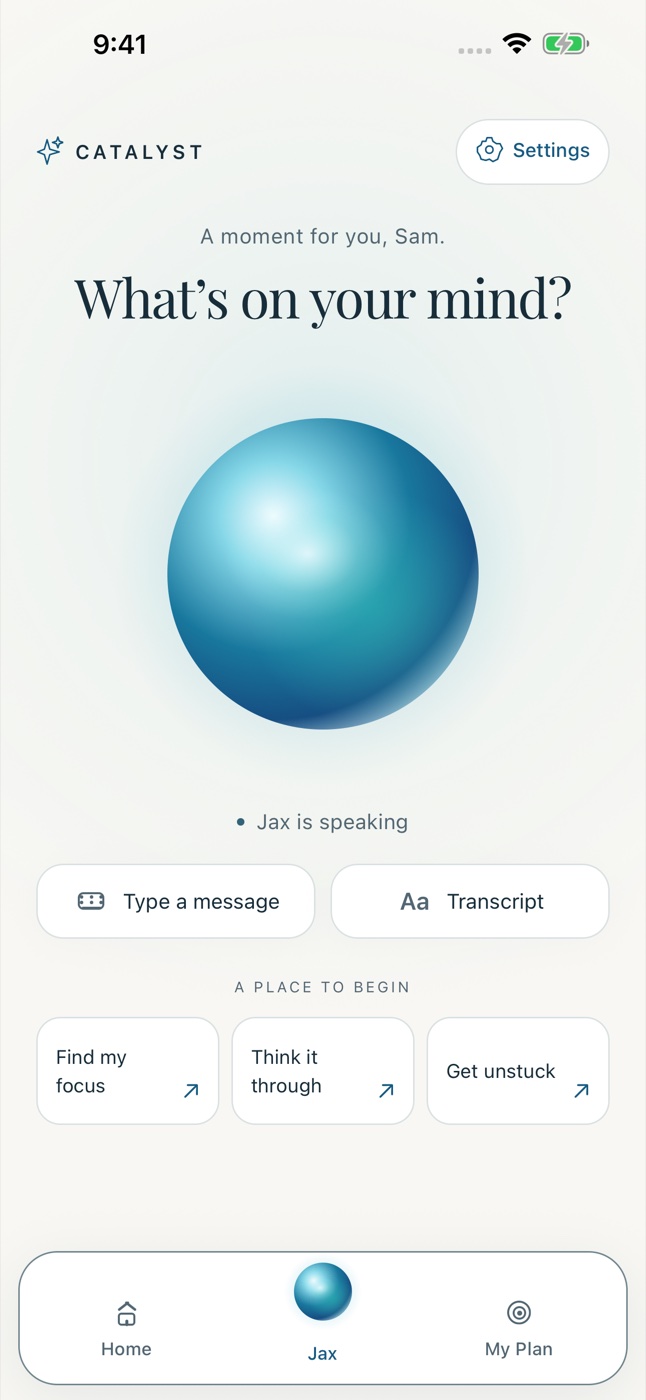
You do not have to sort this alone. In Catalyst, you can say:
"Jax, I have avoided this for months. Help me turn it into a 20-minute first step."
Then tell the truth about why it feels heavy.
Jax can help you separate the task from the story, choose the first physical action, and keep the step small enough to begin. Voice is useful here because typing about the avoided task can feel like another form of avoidance. Speaking is faster. Messier. Often more honest.
After the 20 minutes
When the timer ends, do not immediately raise the standard.
Ask:
- Did I make contact?
- What changed now that I have seen the task again?
- What is the next smallest step?
- Can this wait until tomorrow, or is one more short block useful?
If you continue, great. If you stop, stop cleanly. Leave a note for the next step so the task does not become fog again.
Relief is data
Pay attention to the relief after you touch the task. Even if it is not done, the stress often drops because the unknown shrinks.
That relief teaches your brain something important: contact helps.
The goal is not to become the kind of person who never avoids anything. The goal is to build a reliable way back when avoidance has turned a small task into a shadow.
Twenty minutes can be enough to make the shadow smaller.
If the first step reveals bad news
Sometimes you avoid a task because part of you suspects the first step will reveal something unpleasant: a fee, a missed deadline, a disappointed person, a confusing form, a bigger problem.
That possibility is real. But avoidance does not protect you from the news. It only removes your ability to respond early.
Before the 20-minute step, decide what support you will use if the task reveals something hard. Maybe you will ask someone for help. Maybe you will take a short walk before deciding. Maybe you will talk it through with Jax and separate immediate action from panic.
This pre-decision helps because fear often says, "If I open this, I have to handle everything right now." You probably do not. You only have to discover the next true piece.
The first step is not a contract to solve the whole problem. It is a way to replace dread with information. Information can be worked with. Dread just grows in the dark.
One last test: after reading this, choose one action you could do in less than ten minutes. If the action still feels too large, shrink it until it sounds almost ordinary. Ordinary is not a downgrade. Ordinary is where follow-through becomes possible. The goal is to leave with a next move, not a new reason to judge yourself.