If you keep giving up on your goals, the problem probably is not that you are lazy. More often, the problem is that your goal only exists when you feel motivated.
Motivation is a spark. Follow-through is a system.
That distinction matters because most people set goals in a burst of clarity, then expect that clarity to survive stress, tiredness, bad sleep, work emergencies, family needs, and the quiet shame of falling behind. When the plan breaks, they blame themselves instead of fixing the system.
Catalyst is built for that exact gap: the space between what you said mattered and what your overwhelmed brain can remember to do today.
Why you keep giving up on goals
Most goals fail for one of four reasons.
- The goal is too vague.
- The next step is too big.
- There is no feedback loop.
- Nobody helps you return after you miss a day.
"Get healthier" sounds meaningful, but it does not tell you what to do at 6:15 p.m. when you are tired. "Build my business" sounds ambitious, but it does not tell you whether today's move is sending the invoice, outlining the offer, or following up with the person who went quiet.
When goals stay abstract, your brain has to re-plan them every time you touch them. That is exhausting. So eventually, you stop touching them.
Make the goal smaller than your resistance
The best way to stick to a goal is to make the next action so specific that it creates less friction than avoiding it.
Instead of "work on the project," try:
- Open the document and write the ugly first paragraph.
- Record one voice note about what is blocking me.
- Send one follow-up message.
- Walk for ten minutes before checking email.
Small does not mean unserious. Small is how large goals become real.
Build a return path, not a perfect streak
People who follow through are not people who never fall off. They are people with a fast return path.
The dangerous moment is not missing one day. It is the story that forms after missing one day: "I always do this. I ruined it. I should start over later."
That story turns a slip into a reset spiral. A better system asks, "What is the next honest move?"
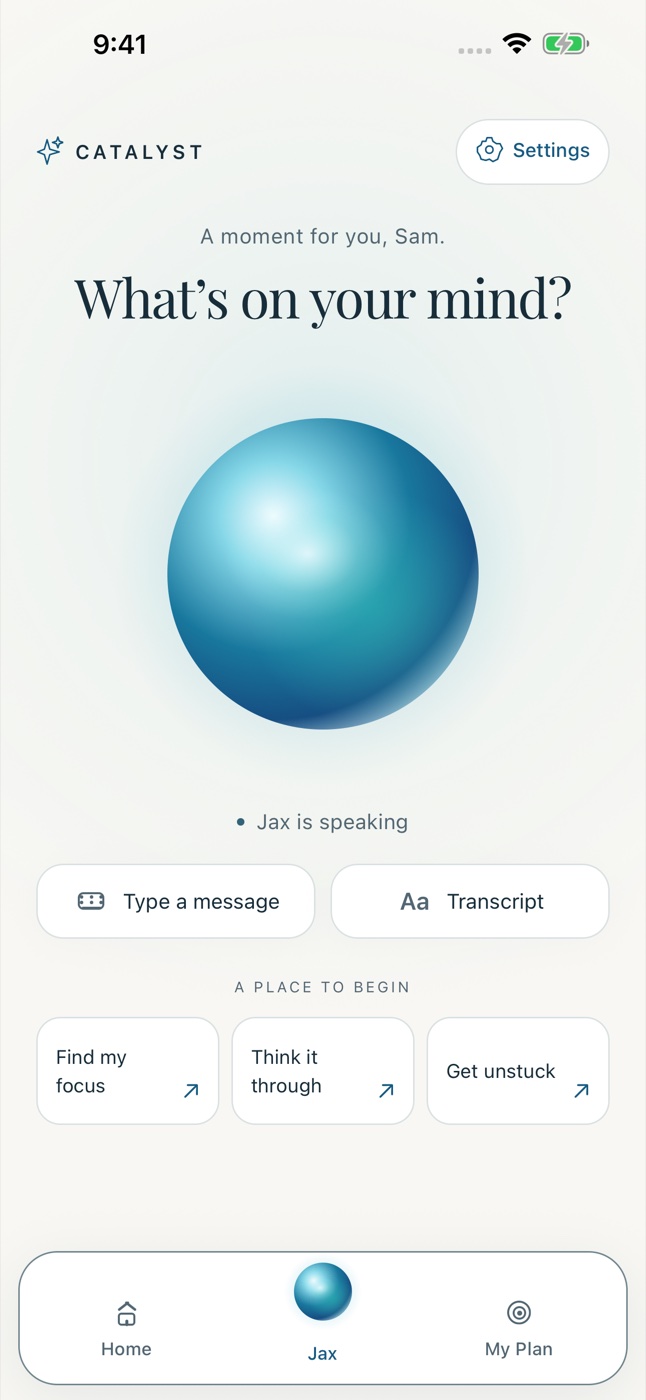
This is where talking to Jax in Catalyst can help. You can say what happened out loud, without having to organize it first. Jax can help you name the blocker, reduce the plan, and choose one next step that fits the day you actually have.
Use voice when your brain is too full
Typing a perfect plan can become another task. When you are overwhelmed, voice is faster and more honest.
Try saying:
"Jax, I keep giving up on this goal. Help me figure out the smallest step I can take today."
Or:
"I have fallen behind and I feel embarrassed. Help me restart without making this huge."
The point is not to perform discipline. The point is to get back into motion before guilt hardens into avoidance.
The Catalyst way to stick with a goal
Here is a simple loop:
- Say the goal out loud.
- Ask Jax to turn it into a next step.
- Do the step today.
- Check in when life interrupts.
- Let the plan adjust instead of disappear.
You do not need a new personality to stick to your goals. You need a system that remembers what matters when you are stressed, tired, busy, or doubting yourself.
That is what Catalyst is for.