You wake up with a plan.
Today will be different. You can feel it for a moment. You know what matters. You imagine yourself moving cleanly through the day, finally doing the thing you have been avoiding.
Then something small happens.
You check one thing. You answer one message. You make breakfast slowly. You do one tiny productive task, feel the edge of relief, and somehow the whole day starts leaking into the screen.
By evening, the important thing is untouched and the shame is loud.
Morning intention is fragile
The first plan of the day often feels stronger than it is. It exists before the world starts making requests.
Once messages, decisions, errands, energy dips, and small interruptions arrive, the plan has to compete. If it is vague, it loses.
"Be productive" is not a plan. It is a mood.
"Work on the project" is closer, but still too broad.
"Open the deck and write the three missing slide titles before anything else" is a plan your day can actually hold.
The first task can steal the day
Sometimes you begin with a small easy task because it feels safe. That is not always wrong. But easy tasks can create false momentum.
You reply to one email, organize one file, tidy one corner, and feel productive enough to avoid the harder thing. The day becomes a chain of low-stakes motion around the task that matters.
The fix is not to become harsher with yourself. The fix is to define the day's anchor before the easy tasks multiply.
Ask:
What is the one action that would make today feel not wasted?
Not the full project. Not the perfect day. One action.
Use a midday rescue
A wasted morning does not have to become a wasted day.
This is where many people lose themselves. At noon or 2 p.m., they decide the day is already ruined. That thought feels logical, but it turns a partial drift into a full surrender.
Try a midday rescue:
- Stop measuring the day against the morning fantasy.
- Name what still matters.
- Choose one action under twenty minutes.
- Do it before making a new full-day plan.
You are not trying to recover the ideal day. You are trying to save a thread of motion.
Reduce the morning decision load
If every morning asks you to decide what matters from scratch, you are spending energy before you start.
Create a simple default:
- One place where the main task waits.
- One first action written the night before.
- One short check-in before screens take over.
- One tiny fallback for low-energy mornings.
The default should be boring. That is the point. Boring defaults reduce negotiation.
Talk the day back into shape
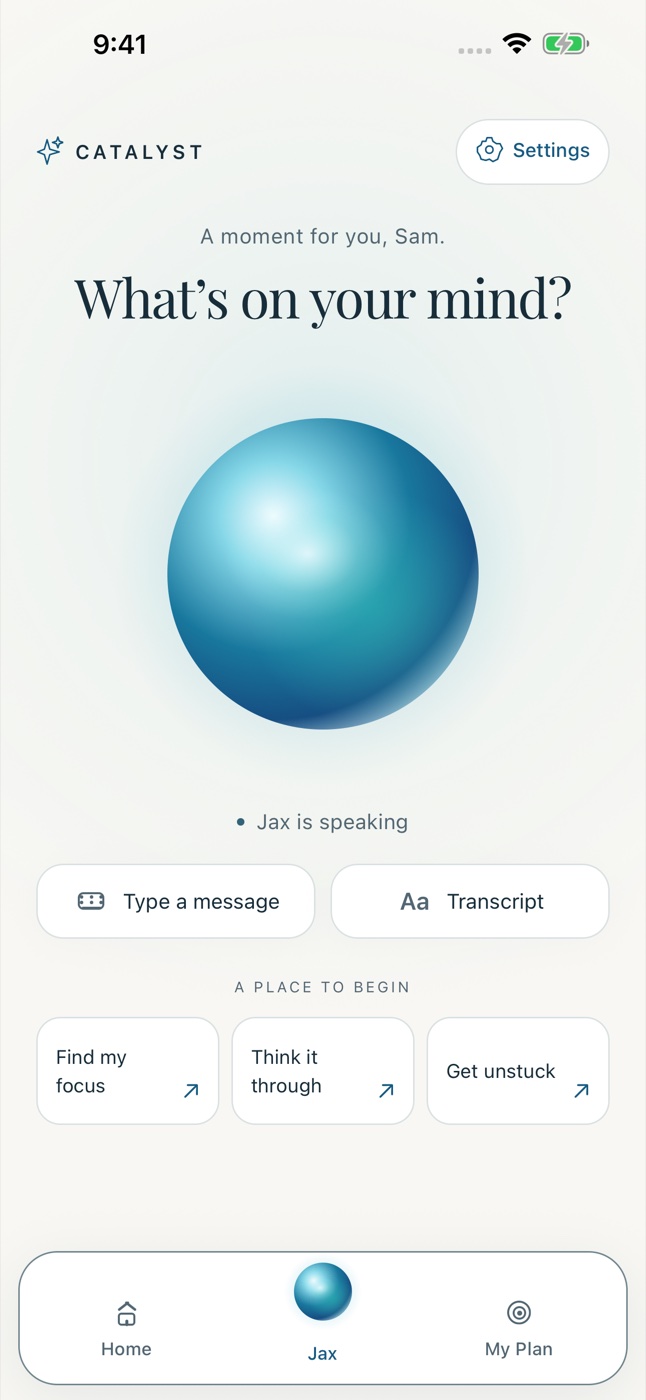
Catalyst can help when the day has already started slipping. You can say:
"Jax, I woke up wanting to be productive and now I have wasted half the day. Help me salvage it without making a huge plan."
Or:
"What is the one action that would make today count?"
Voice matters because the stuck moment is often messy. You may not want to open a planner and confess the drift. Saying it out loud is faster and less ceremonial.
Jax can help you choose one priority, shrink it, and make a restart that fits the hours left.
Build around the real day
The real day includes interruptions. It includes lower energy than you hoped. It includes moments when you lose the thread.
A useful plan does not require the day to stay pristine. It gives you ways to return.
Try naming three versions of the day:
- Full version: what you do if the day goes well.
- Useful version: what you do if the day gets noisy.
- Minimum version: what keeps the thread alive.
Most people only plan the full version. Then anything less feels like failure.
The day is not ruined until you abandon the return
If you wake up productive and waste the morning, the next move is not self-punishment. It is contact.
Open the file. Read one page. Send one message. Put the shoes by the door. Write the ugly first sentence.
A day can be smaller than you hoped and still not wasted.
The skill is learning to come back before shame closes the door.
Create a first-hour guardrail
The first hour does not need to be perfect, but it should have a guardrail. A guardrail is one small boundary that protects the day from scattering too quickly.
Examples:
- Choose the main task before checking the noise.
- Keep the first work block short enough to start.
- Put the easy tasks after the anchor task.
- Ask for the day's one win before opening other loops.
This is not about controlling every minute. It is about preventing the day from being claimed before you have touched what matters.
If the guardrail breaks, do not turn it into a verdict. Use the midday rescue. A day can have more than one beginning.
That sentence is worth remembering: a day can have more than one beginning.
Morning is one doorway. Midday can be another. Evening can still hold one small honest action. The day is not a single fragile object. It is a series of chances to return.
One last test: after reading this, choose one action you could do in less than ten minutes. If the action still feels too large, shrink it until it sounds almost ordinary. Ordinary is not a downgrade. Ordinary is where follow-through becomes possible. The goal is to leave with a next move, not a new reason to judge yourself.